
Lithium-sulfur chemistry combines a high-capacity sulfur cathode with lithium metal, making it one of the most compelling routes toward high specific energy. Solid-state designs may suppress soluble-polysulfide transport and reduce liquid-electrolyte content, but they replace those problems with difficult solid-solid transport, contact, and interface requirements.
Why Lithium-Sulfur Is Attractive
Sulfur is abundant and has a high theoretical specific capacity. Pairing sulfur with lithium metal creates a chemistry with a high theoretical specific energy, but practical cells contain current collectors, separator or solid electrolyte, conductive carbon, binder, packaging, and excess lithium that reduce the realized value.
Liquid Li-S cells also face soluble polysulfide intermediates, shuttle reactions, electrolyte consumption, and lithium-metal instability. Solid electrolytes can change or suppress polysulfide transport, but sulfur and discharge products remain electronically and ionically challenging.
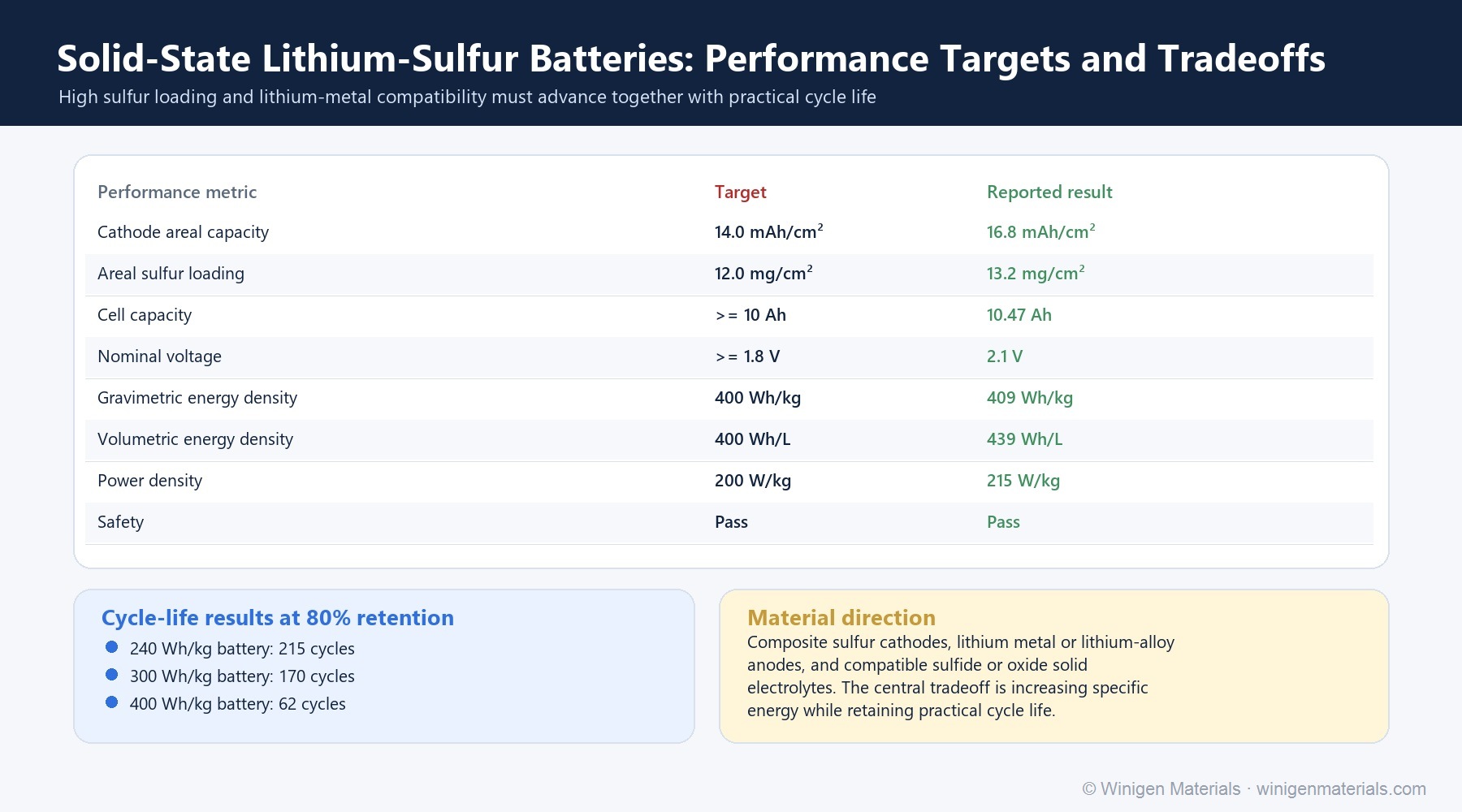
Composite Sulfur Cathodes
A solid-state sulfur cathode normally requires sulfur or sulfurized active material, conductive carbon, and solid electrolyte. These components must form continuous electron and ion pathways while accommodating large reaction-driven volume change.
Increasing solid-electrolyte fraction can improve ionic access but lowers active-material fraction. Increasing sulfur loading raises practical energy potential but makes transport and contact more difficult. Particle size, mixing energy, and interfacial coatings are therefore central variables.
Lithium-Metal and Electrolyte Interfaces
Lithium metal can react with sulfide, oxide, or halide electrolytes. Some decomposition products form partially passivating interphases; others continue to grow or create mixed ionic-electronic conduction. Stripping can form voids, while plating can concentrate stress at defects.
Interlayers, alloy anodes, controlled pressure, and limited lithium excess are common research strategies. Their value must be measured against added mass, resistance, and process complexity.
Practical Screening Metrics
| Metric | Why it matters |
|---|---|
| Sulfur loading (mg/cm2) | Controls areal capacity and practical energy potential |
| Cathode areal capacity | Prevents thin-electrode results from overstating cell relevance |
| Solid-electrolyte fraction | Balances ionic access against inactive mass |
| Lithium excess / N:P ratio | Strongly changes cell-level specific energy and cycle life |
| Pressure | Affects contact, voids, and fracture |
| Impedance growth | Reveals interface and transport degradation |
| 80% retention cycle life | Provides a consistent durability comparison |
Selecting a Solid Electrolyte
Sulfide electrolytes offer high conductivity and mechanical compliance, making them attractive for composite sulfur cathodes. Their chemical reactivity and moisture sensitivity require careful handling. Oxides may offer greater chemical robustness but generally create harder interfaces and more demanding densification.
The best electrolyte depends on cathode design, lithium-metal protection, pressure, temperature, and manufacturing route. Screening should compare complete architectures rather than powder conductivity alone.
References
- Manthiram et al., Rechargeable Lithium-Sulfur Batteries, Chemical Reviews 114, 11751-11787 (2014).
- Janek and Zeier, A solid future for battery development, Nature Energy 1, 16141 (2016).
- Hagen et al., Lithium-Sulfur Cells: The Gap between the State-of-the-Art and the Requirements for High Energy Battery Cells, Advanced Energy Materials 5, 1401986 (2015).
- Pang et al., A comprehensive approach toward stable lithium-sulfur batteries with high volumetric energy density, Advanced Energy Materials 8, 1701589 (2018).
Discuss Your Material Screening Program
Winigen Materials supplies solid-electrolyte materials, lithium metal foil, lithium salts, and electrolyte additives for Li-S screening, and provides material-matching support.
Contact Winigen MaterialsAll original diagrams on this page are © Winigen Materials unless otherwise noted. They may not be reproduced, modified, or redistributed without permission.